Homemade Puff Pastry without Kneading or Folding
With two filling options for Greek cheese pie and spinach and leek pie

Today, you’ll discover an incredibly easy technique for making homemade puff pastry without kneading or the repeated rolling and folding required by the traditional method. Abroad, you may come across it as cheat puff pastry, a quick and clever version that makes the whole process wonderfully simple. It is one of my favorite pastry doughs because it turns out beautifully light, buttery, and so delicate that it practically melts in your mouth.
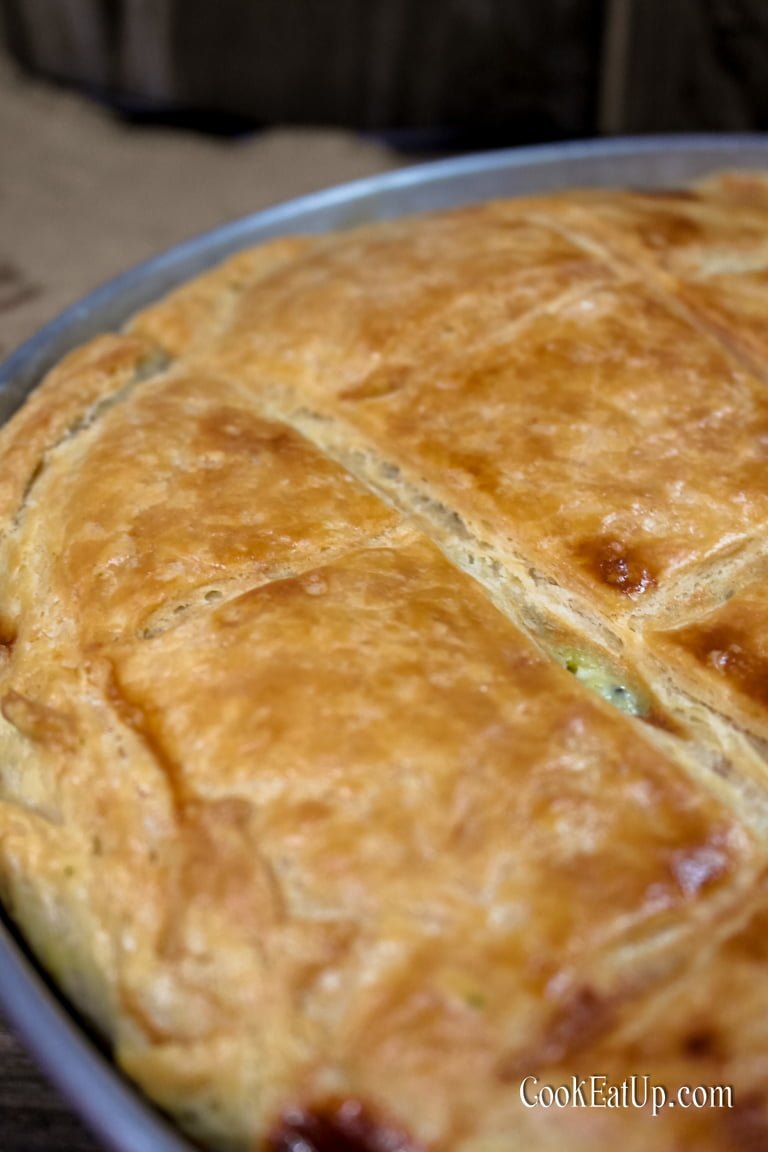
This recipe is based on the easy puff pastry by Irish chef Gemma Stafford, who presents it as a family recipe passed down from her mother. Its secret lies in the tiny flakes of frozen butter distributed throughout the flour. As the pastry bakes, the water contained in the butter turns into steam, separating the dough and creating its characteristic thin, crisp layers.

The lemon juice helps keep the dough tender and pliable by limiting excessive gluten development. The result is a delicious homemade puff pastry suitable for both sweet and savory creations, prepared much more easily than you might imagine. In this recipe, you’ll also find detailed instructions for making a pie, with two filling options: one with cheese and another with spinach and leek. As a little bonus, you’ll use the leftover dough to make irresistible mini croissants!
🛒Ingredients
For the pastry
For a 30 cm (12-inch) baking pan
- 🌾 325 g all-purpose flour
- 🧈 200 g butter or margarine, frozen
- 💧 150 ml ice-cold water
- 🧂 1 tsp salt
- 🍋 1 Tbsp lemon juice
You will also need
- 🥚 1 egg yolk, for brushing
- 🌽 A little cornstarch, for rolling out the pastry
- 🧈 A little butter, for greasing the pan
The quantity above is suitable for a 30 cm (12-inch) pan. For my 42 cm (16½-inch) pan, I double all the ingredients, as one and a half batches are not enough. From the double batch, I reserve approximately one-fifth of the dough to make 8 mini croissants. You will see the method in the instructions. To avoid wasting the egg white, you can add it to the filling.
For the cheese filling
- 🧀 250 g feta cheese, crumbled
- 🧀 250 g anthotyro or cottage cheese, drained if necessary
- 🥚 2 eggs, optional
- 🌶️ Black pepper
For the spinach and leek filling
- 🫒 2 Tbsp olive oil
- 🥬 500 g spinach
- 🧅 1 onion, finely chopped
- 🥬 1 leek, white part only, finely chopped
- 🥚 2 eggs, optional
- 🧀 250 g feta cheese
- 🧂 Salt and black pepper
For a fasting or vegan version, use plant-based margarine and omit the cheese and eggs from the filling. Brush the pastry with a little plant-based milk or olive oil instead of egg yolk.
👩🍳 Instructions
Make the pastry
This technique relies on keeping all the ingredients as cold as possible. Place the butter in the freezer the night before. I always keep a packet in the freezer in case I decide to make this pastry at short notice. You can also chill the bowl of flour in the refrigerator, although this is not essential.

Add the salt to the flour and mix well. Using the coarse side of a grater, grate the frozen butter directly into the flour.

Grate it gradually, gently mixing with a knife from time to time so that the butter flakes become coated in flour and remain separate.

Mix the ice-cold water with the lemon juice and add it gradually in three additions, continuing to mix with the knife.
Once the flour is moistened and begins to come together, gently press the mixture with your hands just until it forms a ball. Do not knead the dough, as the small pieces of frozen butter need to remain intact.
Flatten the dough slightly, wrap it in plastic wrap, and refrigerate it for one hour.
Prepare the filling

As mentioned above, I used a large 42 cm (16½-inch) pan and filled one half of the pie with cheese and the other half with spinach and leek. Each filling quantity listed above is enough for half of the 42 cm pan or for one whole 30 cm (12-inch) pan. If you want to fill the entire 42 cm pan with just one of the fillings, double the corresponding ingredients.

For the cheese filling, combine the feta with the anthotyro or cottage cheese, draining it first if it contains a lot of liquid. Add the eggs, if using, and a little black pepper, and mix until combined.
Personally, I never use feta on its own. I combine it with an equal quantity of an unsalted cheese so that the filling does not taste overly salty.
I often omit the eggs because the filling remains creamier without them.

For the spinach and leek filling, heat the olive oil in a saucepan or large frying pan. Sauté the onion and leek until softened.
Add the spinach and stir gently until it wilts, reduces in volume, and releases all its liquid. Continue cooking until the excess liquid has evaporated.
Season lightly with salt and black pepper, remove from the heat, and allow the mixture to cool completely. Add the lightly beaten eggs and crumbled feta. Be careful with the salt, as feta is already quite salty.
Assemble and bake the pie

After one hour, remove the dough from the refrigerator. If you have prepared a double batch for a 42 cm pan, reserve approximately one-fifth of the total dough, about 275 g. Wrap it in plastic wrap and return it to the refrigerator until you are ready to make the mini croissants. If you have made a single batch for a 30 cm pan, use all the dough for the pie.
Divide the dough for the pie into two pieces. Lightly dust your work surface with cornstarch and roll out the first piece into a sheet slightly larger than the pan.
Place it in the buttered pan, making sure it covers the base and sides. Spread the filling evenly over the pastry.
Roll out the second piece of dough and place it over the filling. Join the two sheets and roll the edges inward to form a raised rim around the pie.
Mix the egg yolk with 1 Tbsp water and brush it over the surface. Cut or score the pie into portions.
Bake in a preheated conventional oven at 180°C (350°F) for approximately one hour, depending on your oven, until the pastry is puffed and deeply golden.
Make the mini croissants

Roll the reserved dough into a circle approximately ½ cm thick. Cut it into 8 equal triangles.
Roll each triangle from the wide end towards the pointed tip to form a mini croissant.

Brush them with the egg-yolk mixture and bake at 180°C (350°F) until puffed and golden.
As they are much smaller than the pie, they will bake more quickly, so keep a close eye on them.

These mini croissants are the bonus of the recipe, and one thing is certain: everyone will ask you to make them again!
For the best results…
🔸 If a little flour remains in the bowl after you have added the 150 ml of water, add only 1 extra Tbsp of ice-cold water and no more. Do not knead the dough. Simply press it gently until the ingredients come together. Do not spend too long trying to incorporate every last trace of flour, as the warmth of your hands will begin to melt the butter.
🔸 If you have an appliance with a grating attachment, even better, as this prevents the butter from coming into contact with your hands and becoming warm. As you grate it, mix it frequently with the flour so that the butter flakes remain coated and do not clump together into a solid mass.
🔸 If you have a food processor, place the flour, salt, and frozen butter cubes in the bowl. Use the pulse function in short bursts until the butter is cut into small pieces and the mixture resembles coarse, flour-coated crumbs. Be careful not to process it for too long, or it may turn into a smooth paste. Transfer the mixture to a bowl and continue as instructed, gradually adding the ice-cold water mixed with the lemon juice.
Enjoy!
Nanà…✍️